The Communist Heritage and Present Moral Crisis in Russia
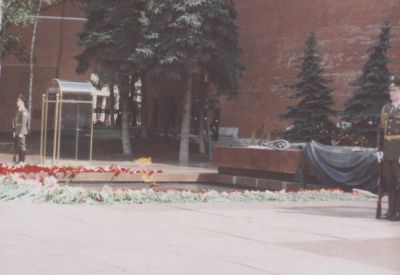
Soviet Rituals in nowadays Russia: The Eternal Flame at the Kremlin Wall, Victory-Day 1998. / Foto: © Lars Karl
There are significant economic, social and political changes after the collapse of communism and its ideological system and principles. It is not surprising that the contemporary moral situation in Russia is often termed a "moral crisis", "value-vacuum" or "value-jungle".
Therefore a lot of different approaches have been made in the search for new values, on the one hand in the direction towards democratic ideas and liberal philosophy, on the other hand towards Russian nationalism and "traditional" Russian values.
To understand such debates correctly, it is necessary to look at the communist background of the present moral crisis in Russia. The essay is to illustrate this background by analysing briefly the principles of "communist morality" and "New Soviet Man", the moral code of the builder of communism, Soviet rites and rituals and the history of anti-religious work in the USSR.
1) The Principles of "Communist Morality" and "New Soviet Man"
The official starting-points of Marxist-Leninist morality were the following:
Firstly, adequate to the Marxist idea of "Historical Materialism", there is supposed to be a connection between morality and the dialectical development of society: In every stage of history, the "spiritual overstructure" (politics, culture, morality, religion) was only a kind of reflected image of the dominant "economic foundation" of the society, e.g. in capitalism the "economic foundation" is considered as a system of exploitation, in which the ruling "bourgeois" class exploits the suppressed working class and therefore uses religious worldviews which teach the exploited to obey the rulers. For a Marxist, the religious ideas of a "paradise" can only exist in feudal or capitalist societies, where life is hard and people have to believe in some kind of "revard" for their worldly sufferings. In communism, religion has got no right to exist because the communist society is like "paradise on earth". According to such a worldview, there can't be any universal and natural "human" values.
One might argue, that there are of course some universal human values, namely such values, which are typically for all cultures (e.g. "don't kill"). The Marxist counter-argument against such an opinion is the idea that such values are not natural "human" values, but only the result of a common learning-process which took place in all cultures and during which people learned what is "benefical" for them.
Another starting-point of Marxist-Leninist morality is the dominant rule of the communist party in defining moral principles and the required "party-mindedness" of the Soviet citizens (partijnost'). Ordinary people are regarded as unable to know what's good or bad, therefore the party has to tell them their obligation towards morality. In consequence, people should follow the principles established by the party. It is often discussed if such a phenomenon can be considered as some kind of religious because it is obvious that the communist party in a communist state has got the same functions as religion in other societies.
According to Marxism-Leninism, the division of "facts" and "values" ("Hume's guillotine") becomes irrelevant in a communist society: In the Soviet Union, the official values, declared by the Communist Party, were regarded as "facts".
Important for the comprehension of "communist morality" is the concept of "positive freedom" and "negative freedom", distinguished by Marxism-Leninism. "Negative Freedom" is considered as a concept of freedom without limitation (e.g. freedom in capitalist societies, whilst communist "positive freedom" is a state of freedom with possibilities (education, community-values etc.).
It is obvous that this ideology is an irreconciliable enemy of all religious worldviews and that anti-religious work is a duty for every convinced Marxist-Leninist: Religions have cheated people and do not offer an adequate worldview, religion passivizes people (promise of "paradise" etc.) and only Marxism should define the meaning of life - and not only in terms of ideology , but in the sense of building the communist society.
All in all, Marxism-Leninism considers the communist morality as superior to all other ethical concepts and theories because it is the only one which knows the true nature of human beings and understands the development and structure of all human societies.

The Ideal of "New Soviet Man": The monumental sculpture "The Worker and the Peasant Woman" ("Rabochy i kolchoznitsa", V. Mukhina) is 79 feet (24 meters) in height and was first exhibited on top of the Soviet Pavilion at the Paris World's Fair (Exposition Internationale) in 1937. Produced in 65 separate laminated stainless steel pieces weighing 75 tonnes, it is now located close to the site of the All-Russian Exhibition Center (VDNKh) in Moscow. / Foto: © Lars Karl
2) The Moral Code of the Builder of Communism
The moral code of the builder of communism spelled out the basic principles of communist morality. Basically, these principles can be devided in "positive moral principles" and "negative moral principles".
"Positive Moral Principles":
- devotion to the cause of communism.
- conscientious work for the good of the society.
- humane and just principles of relations among people.
- mutual assistance: one for all and all for one.
- mutual respect among people: you have to be a friend, comrade and brother.
- honesty, moral purity and modesty in public and private life.
- mutual respect in the family.
"Negative Moral Principles":
- intolerance of injustice, parasitism, dishonesty, careerism and money-grabbing.
- intolerance of national and racial hostility.
- uncompromising attitude towards the enemies of communism.
3) Soviet Rites and Rituals
Soviet rites and rituals were originally introduced as a means of competing directly with religion, and as a medium of direct propaganda. They did eventually gain a momentum of their own and became established features of the Soviet way of life.
During Stalin's time, various non-religious rituals were developed in order to attack the previous religious traditions (e.g. a kind of "family happening" instead of baptism) and to strengthen the position of the leader (e.g. "praising the leader" during party-conferences).
After Stalin's death, the ritual system was reorganized and systematized. During this process, the methods and knowledge of "scientific atheism" "psychology of religion" etc.) played an important role in developing Soviet rituals which were able to replace religious rites most effectively.
Since the 50s, there were three categories of "official rites" in the Soviet Union:
1) The "calendar rites" (prazdniki):
Calendar rites were public holidays connected with a certain programme (parades, speeches, ceremonies etc.):
- 1.1.: "New Year" (novyj god)
- 8.3.: "The International Women's Day"
- 1.5.: "The first of May"
- 9.5.: "The Day of the Victory"
- 7.10.: "The Day of the Constitution"
- 7./8.11.: "The Day of the Revolution"
+ "Communist Saturday" on the day before Easter Sunday.
As can be seen above, the Orthodox church and its holidays were considered as very important for the composition of the Soviet "calendar rites".
2) The "rites of passage":
Rites celebrated at the beginning of a new period of life (admission to the youth organisation, army, university etc.).
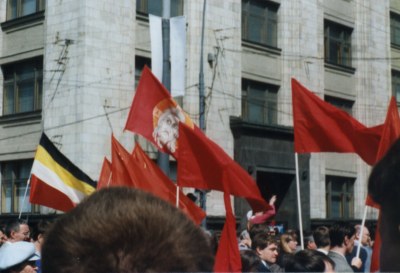
"Value-Jungle": Czarist, Soviet and other flags within a demonstration on Tverskaja Street, Moscow (spring 1998). / Foto: © Lars Karl
3) The rites associated with the cult of Lenin:
Shortly after Lenin's death in 1924, Soviet authorities created the concept of "Leninism" to maintain the authority and the charisma of Lenin among the Soviet people. The basic idea of "Leninism" is: There is Iljich the man and Lenin the immortal; even if Iljich is dead, Lenin is alive in his writings, in the "Leninist" heritage. The parallel to the concept of the nature of Christ in Russia Orthodox tradition is striking: Jesus the man and Christ the immortal. The creation of the concept of "Leninism" can be regarded as the beginning of the typical Soviet "cult of the leader" and also as the beginning of the "cult of the party", in which the Communist Party wasn't any longer a "party" in the common sense of the word, but an object of admiration for the whole population of the USSR.
There are several reasons which can be mentioned for the significance of rituals in Soviet society. The most important one is the fact that those rituals embodied social norms in a clearer and less ambiguous way than it was possible with spoken words. Rituals gave official norms a greater psychological impact and were not as abstract as ideological principles. They can be called with good reason an "ideology for common people".
Secondly, the system of "Soviet rituals" also gave social norms greater stability and ensured lasting control (communist rituals + communist principles = more stable principles + ability to control principles).
Thirdly, "Soviet rituals" channelled individual and group emotions and satisfied aesthetic needs ("Socialist Realism" = the official line in arts) and - last but not least - supported the political status quo in the Soviet Union (e.g. the demonstration of power during parades etc.)
Parallels between Marxist-Leninist rituals in the USSR and religious rituals in other societies are obvious and many attempts have been made to proof that Marxist-Leninism can be considered as a religion. Of course, the validity of those proofs depend on the definition of religion. But if we devide the term "religion" into different dimensions, there can be found several dimensions of religion in Marxist-Leninism:
- belief (ideological) dimension: belief in the development of communism = "paradise on earth".
- knowledge (intellectual) dimension: scientific part of the ideology; theory of M.-L. = "closed system", which has an answer for every question.
- practise (ritualistic) dimension: Soviet rites and rituals.
- experience dimension: practised collectivism.
- consequential dimension: applying to the official norm system.
One interesting parallel between Marxism-Leninism and religion which should also be mentioned is the phenomenon of "holy scriptures" and "dogmatization" within the Marxist-Leninist ideology.
The highest instance in the hierarchy of Soviet "holy scriptures" were the scripts of Marx and Engels, which were regarded as the most important signposts within the ideological system of Marxism-Leninism. The second rank of the hierarchy was hold by Lenin, who, according to the above mentioned concept of "Leninism", was regarded as the person who really understood Marx and Engels. During the reign of Stalin, the Grusinian dictator declared himself as the person who really understood Lenin and Marx/Engels. His book "A history of the Communist Party of the Soviet Union (Bolsheviks): A short Course" was studied in all schools and universities within the USSR. After Stalin's death and the "thaw" under Khrushchev, the decisions of the Communist Party became the most relevant institution in the interpretation of the Marxist-Leninist heritage. Till the end of the Soviet Union, several approaches had been made to different problems of Marxism-Leninism according to present ideological purposes.
In spite of the fact, that those Party-decisions were sometimes contradicting, there was no differentiation of the scripts of the "Early Marx" and those of the "Later Marx" but only "Official Marxism" which can be considered as an "official dogma". The similarity to the development of dogmatization within the Christian religion is obvious.
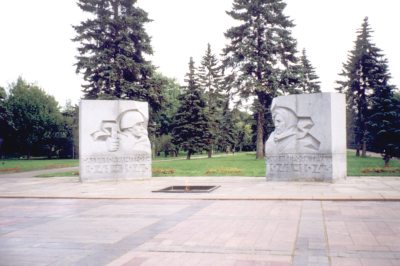
Dedicated to the Heros of the Soviet State: Victory Monument in Jaroslavl, Volga Region. / Foto: © Lars Karl
4) Anti-Religious Work and Communist Morality
During the whole history of the USSR, several attempts had been made to set the ideas of "communist morality" into practise and to overcome the "reactionary morality" of prerevolutionary Russia, especially to destroy the status of Russian Orthodoxy within the society. It is necessary to mention that the Russian Orthodox church had a very firm position in Czarist Russia, but that the overwhelming majority of its believers possessed only a weak knowledge about contents and basic doctrines of their religion. Most important for the typical Russian Orthodox Christian were the church rituals and holidays, which played a very significant role in the rural society of pre-modern Russia.
After the Revolution and during the civil war, the new Soviet power fought the structures of the Russian Orthodox Church by force and was thereby supported by a large number of people, who voluntarily took part in this fight. This participation of the population can be explained by the fact that there was traditionally no close relationship between clericals and believers in Russia, which led to the phenomenon that ordinary believers (which were normally very poor) only saw the luxury of their religious authorities without really knowing them. The result was the - psychologically understandable - reaction that a lot of those people favoured aggression towards religious structures.
During the 20s, the Soviet government declared some tolerance towards religious institutions. Especially Orthodox sects which were traditionally in opposition to the official Orthodox Church, received some support from the state. Nevertheless there was a "party commission of anti-religious work", founded in 1922, and since the end of the same year, a anti-religious journal called "Bezbozhnik" ("Godless") was published and distributed within the USSR. In 1924, the "Union of the Friends of the journal "Bezbozhnik" " came into existence. This organisation, since 1925 called the "Union of the Soviet "Bezbozhnik" ", became more an more organized and dominated by two competing lines: The radical atheists, who supported hard attacks against religious structures and believers, and the moderate ones, who wanted to confine themselves on the ideological fight against religion and rejected the idea of persecution. The radical wing became increasingly dominant and at the end of the 20s, the organisation was renamed in "Union of Militant Atheists". All in all, it can be said that during the 20s, there was in general a quite tolerant attitude towards religion and religious institutions, but at the same time some groups of atheists acted and were increasingly supported by the state. The ideological basis of this policy was the "Leninist principle" towards religion which can be regarded as a kind of double standard: On the one hand, Lenin declared religion as a "private matter" of every citizen, on the other hand he found it necessary to attack clericals in a manner, that they can never survive.
At the end of the 20s, at the beginning of Stalin´s "Second Revolution", the official policy changed abruptly. The Stalinist terror against several groups of the population also affected the Russian Orthodox Church and their believers. The open suppression of clericals and believers reached its top in 1937, when 137 000 bishops, priests and monks were arrested, deported and killed.
The "Union of Militant Atheists" became a mass organisation (5.5 mio. members in 1932). It has to be mentioned that the leaders of this institution were executed a few years later because they were not able to fulfil their five-year-plan. The goal of this five-year-plan was the total liquidation of religious attitudes on the territory of the USSR till 1935. But in this year, still 50% of the Soviet population considered themselves as "believers". Another reason for the liquidation of the "Militant Atheists" was Stalin's idea to create a quasi-religious "Leader-and-Party-Cult" with a quasi-religious Marxist-Leninist ideology as its fundament. Convinced opponents of religion could have been an obstacle for such an intention.
With the beginning of the Second World War, Stalin changed his policy concerning religion to mobilize all Soviet citizens toward the common enemy. This tactical shift brought a slowdown in atheistic activities, the release of clericals and the reconstruction of churches. Stalin asked the church to support his efforts to win the war against Germany, and therefore re-established the patriarchate of the Russian Orthodox Church in 1943 and allowed the foundation of 44 organisations for religious minorities ("Union of Baptists" etc.).
During the late 1940s and early 1950s, these tolerance still remained because the destroyed country had to be build up again. Nevertheless several initiatives were undertaken to promote atheistic work.
After Stalin's death, a new direction in atheistic propaganda could be observed: Before the Second World War, atheism consisted in primarily practical atheistic work with little theoretical study of religion. During the 1950s "Scientific Atheism" became an established discipline at Soviet universities (50 faculties in the whole USSR). The journal "Nauka i religija" gave clear guidelines for the treatment of religion: religious worldviews should be overcome through the knowledge of "Scientific Atheism".
5) Conclusions
In spite of the fact that it is very difficult to measure and date an intellectual process, it can be said that since the end of the Khrushev-era, Marxism-Leninism had lost its persuasive power and credibility for the Soviet people. The more the ideal of the "Homo Soveticus" in a communist society deviated from the reality in the Soviet Union, the Leninist doctrines became gradually ritual formulas which provided the Soviet citizens with necessary proofs for their ideological loyalty and protected him against detriment.
It's obvious that under these circumstances the communist ideology couldn't be a motivating force any longer and that the praised "communist society" became a facade, a village of Potemkin, a deceitful heightening.
But apart from this lack of real persuasive-power, Marxism-Leninism was the only orientating line for the overwhelming majority of the inhabitants of the Soviet Union and the only cohesive force in Soviet society. For that reason the failure of Marxism-Leninism and the implosion of its ideological system led to a serious moral crisis in the contemporary states of the former Soviet Union.
l.k. / Februar 2003
Literature
Ennker, B.: Die Anfänge des Leninkults in der Sowjetunion. Köln 1997.
Karl, L.: Der "Tag des Sieges" in der Sowjetunion - Inszenierung eines politischen Mythos. Tübingen 1999.
Lane, Ch.: The rites of rulers: ritual in industrial society - the Soviet case. Cambridge 1981.
|
|
 |
|